MAYROS — Your AI Agent, Everywhere
The world's first semantic agent framework with verifiable intelligence.
MAYROS is a personal AI agent that runs on your devices, answers on your messaging channels, and proves what it knows. Built on AIngle's cryptographic semantic layer, MAYROS doesn't just generate text — it stores, reasons over, and cryptographically proves facts. It is the natural evolution of AI assistants: from black-box chatbots to accountable, multi-device, multi-channel intelligent agents.
Why MAYROS Exists
Every AI assistant today has the same fundamental problem: you can't verify what it knows.
ChatGPT tells you something. You trust it — or you don't. There's no proof, no audit trail, no way to verify that Fact A was derived from Evidence B using Rule C. When AI agents start making real-world decisions — approving transactions, verifying identities, managing infrastructure — "trust me" isn't good enough.
MAYROS solves this with Proof-of-Logic: every fact your agent stores is a cryptographically signed RDF triple in a semantic knowledge graph. Every inference is a verifiable derivation chain. Every sensitive value can be committed and proven in zero knowledge. Your agent doesn't just say things — it proves them.
The Architecture
                         You
                          |
          +-----------+---+---+-----------+
          |           |       |           |
       WhatsApp   Telegram  Slack     Discord    ... 20+ channels
          |           |       |           |
          +-----+-----+-------+-----+-----+
                |                     |
         MAYROS Gateway (Node.js)    AIngle Cortex (Rust)
         WebSocket + HTTP            REST / GraphQL / SPARQL
         Agent Engine                RDF Triple Store
         Tool Registry               Rule Engine
         Plugin System               ZK Proofs
         Session Manager             Neural Memory (STM/LTM)
                |                     |
    +-----------+-----------+---------+---------+
    |           |           |         |         |
  macOS       iOS        Android    Docker    IoT Nodes
  (native)   (native)   (native)   (server)  (aingle_minimal)
MAYROS is a gateway + node architecture. One machine runs the gateway — the brain. Every other device connects as a node, exposing its capabilities (camera, GPS, screen, sensors) to the agent. Messages flow in from any channel, the agent processes them with full tool access, and responses flow back — all in real time.
Runs Everywhere
20+ Messaging Channels
Your agent lives where you already communicate. No new app to install for your users:
| Category | Channels |
|---|---|
| Consumer | WhatsApp, Telegram, iMessage, Signal, LINE, Zalo |
| Enterprise | Slack, Microsoft Teams, Google Chat, Mattermost |
| Community | Discord, IRC, Twitch, Matrix, Nostr |
| Regional | Feishu/Lark, Zalo, Nextcloud Talk, Tlon/Urbit |
| Native | BlueBubbles (Apple Messages proxy) |
Every channel is a first-class plugin. Adding a new channel is implementing one interface. Messages from all channels converge in a single agent session — start a conversation on Telegram, continue it on Slack, approve an action from your Apple Watch.
Native Apps
| Platform | Technology | Highlights |
|---|---|---|
| macOS | Swift 6 + AppKit/SwiftUI | Menu bar agent, local gateway host, Tailscale wide-area networking, WebChat panel, exec approval dialogs, voice wake |
| iOS | Swift 6 + SwiftUI | Camera, GPS, contacts, calendar, reminders, screen recording, voice wake, APNs push-wake, Live Activities |
| Apple Watch | WatchKit | Approval prompts on the wrist — approve agent actions with a tap |
| Android | Kotlin + Jetpack Compose | Camera, SMS, GPS, canvas, voice wake with on-device speech recognition, foreground service for always-on |
Server Deployment
| Mode | Description |
|---|---|
| Docker | mayros-gateway + mayros-cli containers. Optional browser sandbox with Chromium + VNC |
| Bare metal | Node.js 22+ on Linux/macOS/Windows (WSL2) |
| Tailscale | One command to expose your gateway securely across the internet — no port forwarding, no DNS config |
IoT / Edge
The IoT Bridge extension connects MAYROS agents to AIngle Minimal edge nodes — lightweight Rust binaries running on embedded hardware. Agents can:
- Query sensor data from a fleet of up to 50 IoT nodes
- Publish structured observations (temperature, humidity, motion, etc.)
- Manage fleet health with per-node circuit breakers and background polling
- Content-address all sensor readings in a DAG store
20+ AI Providers
MAYROS supports the widest range of AI providers of any self-hosted agent framework:
| Category | Providers |
|---|---|
| Frontier | Anthropic (Claude Opus/Sonnet), OpenAI (GPT-4), Google (Gemini 3 Pro/Flash) |
| Enterprise | Amazon Bedrock (multi-region auto-discovery), GitHub Copilot, Cloudflare AI Gateway |
| Chinese AI | MiniMax, Moonshot/Kimi, Qwen, VolcEngine/BytePlus, Xiaomi Mimo, Baidu Qianfan |
| Open Source | Ollama (auto-discovers all local models), vLLM, Together AI, HuggingFace, Venice AI |
Auth profile rotation: Configure multiple API keys per provider. MAYROS round-robins across them with cooldown-aware failover — if one key hits rate limits, the next one picks up instantly.
Model failover: If Claude is down, fall back to Gemini. If Gemini is down, fall back to a local Ollama model. Configurable fallback chains with automatic recovery.
The Semantic Layer: AIngle
What makes MAYROS fundamentally different from every other AI agent framework is AIngle — a purpose-built Rust semantic computation engine that runs as a sidecar to the gateway.
RDF Knowledge Graph (aingle_graph)
Every fact your agent learns is stored as an (Subject, Predicate, Object) triple with rich metadata:
- Content-addressed: Every triple has a BLAKE3 hash ID. The same fact always has the same ID — globally deduplicated by construction
- Provenance tracking: Who asserted this fact, when, with what confidence, and is it cryptographically signed?
- Triple indexing: SPO, POS, and OSP indexes enable O(log n) queries on any axis
- W3C standard: Import/export Turtle and N-Triples. Query with SPARQL 1.1. Interoperate with any semantic web toolchain
- Storage backends: In-memory, Sled (embedded ACID), RocksDB (high-throughput), SQLite
sparqlSELECT ?agent ?capability ?confidence WHERE { ?agent mayros:hasCapability ?capability . ?agent mayros:confidence ?confidence . FILTER (?confidence > 0.8) }
Proof-of-Logic Engine (aingle_logic)
Goes beyond signature verification. The rule engine validates the logical consistency of knowledge:
- Forward chaining: Data-driven inference to fixpoint — derive all possible facts from rules
- Backward chaining: Goal-driven Prolog-style reasoning with proof trees
- Rule types: Integrity constraints, authority rules, temporal constraints, inference rules
- Verifiable derivations: Every inferred fact comes with a
ProofStepchain showing exactly which rules and base facts produced it
Rule: "If agent has KYC level >= 2 AND is in approved jurisdiction,
       THEN agent is verified for financial operations"

Result: {
  proven: true,
  proof: [
    { rule: "kyc-level-check",  triple: "agent:alice kyc:level 3" },
    { rule: "jurisdiction-check", triple: "agent:alice geo:jurisdiction US" },
    { rule: "financial-verify",  triple: "agent:alice fin:verified true" }
  ]
}
This is Proof-of-Logic — not just "this was signed" but "this was derived from these rules applied to these verified facts."
Zero-Knowledge Proofs (aingle_zk)
Privacy-preserving cryptography on Curve25519/Ristretto with 128-bit security:
| Primitive | What It Proves | Use Case |
|---|---|---|
| Pedersen Commitments | Value is committed without revealing it; supports homomorphic addition | Confidential agent state, budget tracking |
| Schnorr Proofs | Knowledge of a secret without revealing it | Agent identity, capability attestation |
| Equality Proofs | Two commitments hide the same value | Cross-agent consistency verification |
| Merkle Membership | Element is in a set without revealing the set | Permission verification, group membership |
| Sparse Merkle Non-Membership | Element is NOT in a set | Blocklist verification |
| Bulletproof Range Proofs | Value is in [0, 2^n) without revealing it | Age verification, credit score thresholds |
Batch verification: 4x speedup for Schnorr proofs using random linear combination. Verify hundreds of proofs in the time it takes to verify a few dozen individually.
Cognitive Memory (ineru)
Inspired by human episodic vs. semantic memory:
- Short-Term Memory (STM): Fast, bounded, attention-weighted with decay. Important facts float to the top; irrelevant ones fade
- Long-Term Memory (LTM): Persistent knowledge graph with entities, typed links, and semantic embeddings for meaning-based recall
- Automatic Consolidation: Importance-scored, similarity-aware transfer from STM to LTM. Your agent doesn't forget — it prioritizes
- Two modes:
agent_mode(full capacity for desktop/server) andiot_mode(minimal footprint for edge devices)
AIngle Cortex — The API Surface
Everything above is exposed through one sidecar process with three API surfaces:
- REST API (
/api/v1/) — triples CRUD, pattern queries, proof validation, memory operations, skill verification, reputation scoring - GraphQL (
/graphql) — full schema with queries, mutations, and live subscriptions for real-time triple changes - SPARQL (
/sparql) — W3C SPARQL 1.1 compliant endpoint for standard semantic web queries - WebSocket events — real-time notifications:
TripleAdded,TripleDeleted,ValidationCompleted
Cortex includes JWT-based RBAC authentication, IP-based rate limiting, namespace-scoped multi-tenancy, and a tamper-evident JSONL audit log.
The Agent Engine
Multi-Agent Mesh
MAYROS agents don't work alone. The Agent Mesh extension enables:
- Knowledge sharing: Agents push and pull RDF triples across namespaces with ACL enforcement
- Delegation: Parent agents spawn child agents with semantic context — relevant triples and memories are automatically injected
- Knowledge fusion: Merge namespaces using 5 strategies: additive, replace, conflict-flag, newest-wins, majority-wins (voting across multiple agents)
- Conflict detection: Identify contradicting facts between agent namespaces before merging
- Namespace ACL: Read/write/admin access grants stored as content-addressed RDF triples — the ACL itself is tamper-evident
Tool System
50+ built-in tools organized into policy groups:
| Group | Tools |
|---|---|
| File System | read, write, edit, apply_patch |
| Runtime | exec (with approval system), process management |
| Web | web_search, web_fetch, browser (full Playwright automation) |
| Sessions | sessions_spawn (subagents), sessions_send, sessions_list |
| Messaging | message (any channel), discord_actions, slack_actions, telegram_actions, whatsapp_actions |
| Memory | memory_search, memory_get |
| UI | canvas (live interactive rendering), tts (text-to-speech) |
| Infrastructure | gateway, cron, nodes |
Tool profiles: minimal, coding, messaging, full — configure exactly what each agent can do.
Exec approval system: Shell commands require human approval before execution. Safe binaries are allowlisted; everything else pops up a native dialog (macOS) or notification (mobile) for the user to approve or deny.
29 Plugin Lifecycle Hooks
Deep integration points at every stage of the message-to-response pipeline:
message_received → before_model_resolve → before_prompt_build → llm_input →
llm_output → before_tool_call → after_tool_call → message_sending → message_sent
Plus: session_start/end, agent_end, subagent_spawning/spawned/ended, before_compaction, gateway_start/stop, permission_request, notification, teammate_idle, task_completed, config_change, and more. Every hook can inspect, modify, or cancel the operation.
Proactive Agent (Heartbeat)
MAYROS agents don't just respond — they act proactively:
- Scheduled tasks: Cron-style heartbeat runner with configurable active hours
- Monitoring: Agents can watch APIs, check sensors, and alert you before you ask
- Ghost reminders: Background prompts that trigger agent actions without user initiation
The Skill Revolution
Semantic Skills
MAYROS skills go beyond simple tool wrappers. A semantic skill:
- Declares capabilities in a structured YAML frontmatter: what graph operations it needs, what proofs it can request, what memory it accesses
- Runs verified: Every install passes a 4-stage verification pipeline
- Proves its work: Assertions are stored as RDF triples with optional Proof-of-Logic and ZK proofs
- Respects boundaries: Per-skill tool allowlists, query limits, and namespace isolation
yaml# SKILL.md frontmatter name: verify-kyc type: semantic semantic: permissions: graph: [read, write] proofs: [request, verify] assertions: - predicate: "kyc:verified" requireProof: true queries: - predicate: "kyc:level" scope: agent
5-Stage Verification Pipeline
No skill touches your agent without passing all five gates:
| Stage | What It Checks |
|---|---|
| Static Scan | 16 rules detect: code execution, crypto mining, data exfiltration, sandbox escape, env harvesting, obfuscation, dynamic import/require |
| Ed25519 Signature | Author's public key, file hash integrity, canonical signature verification |
| Proof-of-Logic | Ontological consistency of declared assertions against the AIngle knowledge graph |
| WASM Sandbox | Skills execute in QuickJS WASM — no fs, net, process, require, import. Only 7 host functions exposed |
| Sandbox Test | Live execution in a TTL-scoped isolated namespace — tear down after verification |
Verify-then-promote: Skills are extracted to a temp directory, verified there, and only moved to the live directory on success. Failure leaves zero residue.
Apilium Hub Marketplace
Publish, discover, and install skills with full supply chain integrity:
- Ed25519 challenge-response auth: Cryptographic identity, not passwords
- Dependency resolution: Semver-aware topological sort with cycle detection
- Author reputation: Trust tiers computed from on-chain assertion consistency — not stars or download counts
- Lockfile pinning:
skills.lockensures deterministic reinstalls - Hot-reload: Change a
SKILL.mdorskill.tsand it reloads mid-session — no restart needed
Forge CLI
Build skills in seconds:
bashmayros forge init my-skill # Scaffold with SKILL.md + skill.ts mayros forge test my-skill/ # Run full verification pipeline locally mayros forge autocomplete "kyc:" # Discover predicates from your knowledge graph mayros forge publish my-skill/ # Sign, package, upload to Apilium Hub
Security by Design
MAYROS was built with the assumption that every component — skills, plugins, channels, even the AI model itself — is potentially adversarial.
18 Security Layers
| Layer | Mechanism | Guarantee |
|---|---|---|
| L0: Data Integrity | BLAKE3 content-addressed triple IDs | Every fact is globally unique and tamper-evident |
| L1: ZK Primitives | Pedersen, Schnorr, Bulletproofs (Curve25519) | Privacy-preserving proofs without trusted setup |
| L2: Merkle Trees | Standard + Sparse with non-membership proofs | Set membership and exclusion proofs |
| L3: Agent Identity | Ed25519 public keys as content-addressed hashes | Unforgeable agent identity |
| L4: Skill Signing | Ed25519 over canonical SHA-256 file hashes | Tamper-evident skill packages |
| L5: Knowledge Graph | ACL-guarded RDF triples with provenance | Namespace-isolated, auditable knowledge |
| L6: Proof-of-Logic | Forward/backward chaining with proof trees | Verifiable inference chains |
| L7: WASM Sandbox | QuickJS WASM with 7 host functions only | Complete Node.js API isolation |
| L8: Verification Pipeline | Scan + signature + PoL + WASM + sandbox test | 5-factor install verification |
| L9: Runtime Enforcement | Tool allowlists (intersection model) + permission resolver | Per-skill least-privilege |
| L10: Namespace Isolation | Forced ns prefix on all queries + defense-in-depth | No cross-namespace data access |
| L11: Rate Limiting | Sliding window per skill per minute | Anti-brute-force on sandbox calls |
| L12: Enrichment Sanitizer | Unicode normalization + 8 injection patterns + depth limits | Anti-prompt-injection on skill output |
| L13: Query/Write Limits | Per-skill counters + global caps | Resource exhaustion prevention |
| L14: Execution Timeout | QuickJS interrupt handler + 2s enrichment timeout | DoS prevention |
| L15: Atomic Hot-Reload | Manifest validation + diff logging + downgrade block | No security regression on reload |
| L16: Path Traversal | Reject .. + isPathInside() double-check | Archive extraction safety |
| L17: Resilience | Circuit breaker + exponential backoff | Graceful degradation without security regression |
Static Analysis Scanner
16 rules with zero tolerance for critical findings:
- Code execution:
exec,spawn,eval,new Function, bracket-notation evasion (obj["exec"]) - Data exfiltration:
readFile+fetchcombination,process.env+ HTTP - Sandbox escape:
globalThis[...]bracket access, dynamicrequire(), dynamicimport() - Crypto mining: stratum+tcp, coinhive, xmrig patterns
- Obfuscation: hex escape sequences, long base64 +
atob/Buffer.from - Anti-evasion: comment stripping, line-join preprocessing, nested parens tracking
Exec Approval System
Every shell command passes through human approval:
- Safe binary allowlist:
git,ls,cat, etc. bypass approval - Everything else: Native macOS dialog, mobile notification, or Apple Watch prompt
- Dangerous tool denylist:
sessions_spawn,gateway,whatsapp_loginblocked from HTTP API by default
Circuit Breaker Resilience
All Cortex communication uses a three-state circuit breaker (closed → open → half-open) with exponential backoff retry. When Cortex is down, the agent gracefully degrades to markdown-based memory — never crashes, never hangs.
Token Economy
Track and control AI costs at every level:
- Per-session, daily, and monthly budgets with configurable limits
- Three-tier enforcement: OK → Warn (at 80%) → Exceeded (soft-stop or hard-block)
- LRU prompt cache: SHA-256 memoization of repeated prompts (256 entries, 5-minute TTL)
- Persistence: Atomic file I/O to
~/.mayros/token-budget.jsonwith automatic day/month rollover
bashmayros budget status # Current spend vs. limits mayros budget set session 2.50 # $2.50 per session cap mayros budget set monthly 100 # $100/month cap mayros budget cache # Cache hit stats and estimated savings
Semantic Observability
Full tracing of agent decisions as RDF events:
- Tool calls: What was called, with what arguments, what it returned, how long it took
- LLM calls: Token counts, timing, model used, cost
- Delegations: Which subagent was spawned, why, what context was injected
- Causal chain analysis: "Why did this happen?" — trace back through the decision graph
- Prometheus metrics: Export counters and gauges to Grafana for real-time dashboards
Voice Interface
Swabble
A native Swift speech pipeline that runs entirely on-device — zero network usage for wake-word detection:
- macOS 26:
SpeechAnalyzer+SpeechTranscriberfrom the new Speech framework - iOS:
AVAudioEnginetap →SFSpeechRecognizerpipeline - Android: Native
SpeechRecognizerwith three modes (off, foreground, always-on) - Wake word: Configurable trigger word with gap-based command extraction
- Talk mode: Full bidirectional voice conversation with the agent
Voice Calls
PSTN voice call integration supporting Telnyx, Twilio, and Plivo:
- Inbound and outbound calls
- STT via OpenAI Whisper
- TTS via OpenAI, ElevenLabs, or Edge TTS
- Optional OpenAI Realtime streaming
- Configurable inbound policies (disabled, allowlist, pairing, open)
Browser Automation
Full Playwright-powered browser control:
- Snapshot pages (accessibility tree + screenshots)
- Click, type, navigate, scroll, evaluate JavaScript
- Multiple Chrome profiles
- CDP (Chrome DevTools Protocol) for low-level access
- Sandboxed browser containers with Chromium + VNC for visual debugging
- AI-assisted visual page understanding
Developer Experience
Terminal UI (TUI)
A rich interactive terminal with three themes (dark, light, high-contrast), vim mode with motions and operators, @ file mentions with Cortex-enriched autocomplete, inline diff viewer, and context window visualization.
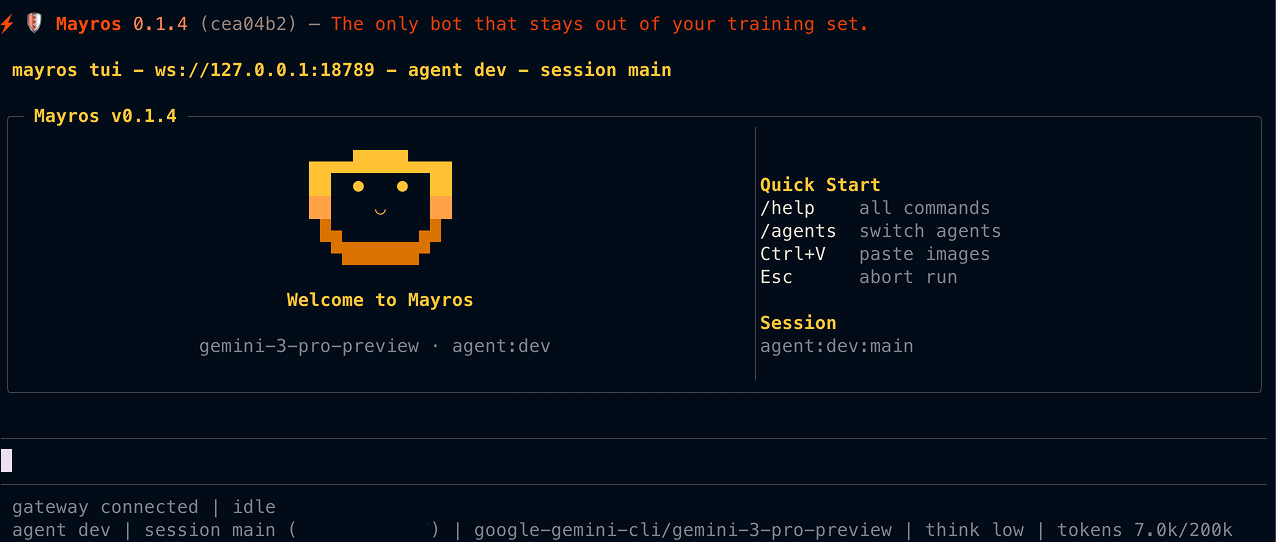
IDE Integration
VSCode extension with three tree views (agents, sessions, tools), four webview panels (chat, graph, traces, dashboard), and real-time Gateway sync. The ACP bridge connects any IDE to the Mayros Gateway over WebSocket.
MCP Server
Run mayros serve to expose all Mayros tools and resources via the Model Context Protocol. Compatible with Claude Code, Cursor, Windsurf, and any MCP client. Supports stdio and HTTP transports.
Headless CLI
Run prompts non-interactively:
bashmayros -p "summarize this repo" # Pipe prompt, get result echo "review PR #42" | mayros -p - # Stdin input mayros -p "audit deps" --json # JSON-lines output for CI
Plan Mode
Cortex-backed multi-step planning with a structured lifecycle:
mayros plan start— Create a new planmayros plan explore— Research and gather contextmayros plan assert— Store verified findingsmayros plan approve— Review and approve the planmayros plan execute— Run the approved plan
P2P Sync
Native peer-to-peer sync between devices using a dual-mode bridge:
- Native P2P: Direct device-to-device sync via CortexClient
- Polled fallback: REST-based sync when direct connection isn't available
- Pairing: Secure device pairing with approval flow
- Gossip protocol: Efficient data propagation across the mesh
Why We're Different
vs. LangChain / CrewAI / AutoGen
These frameworks give tools to agents and trust the tool author. MAYROS adds:
- Verifiable facts: Every assertion is a content-addressed, cryptographically signed triple — not a string in a chat message
- Proof-of-Logic: Derivation chains that any third party can verify
- Zero-knowledge proofs: Prove facts without revealing underlying data
- 5-stage skill verification: Static scan + signature + PoL + WASM sandbox + sandbox test before any code runs
- Multi-channel delivery: 20+ channels vs. API-only
vs. OpenAI Assistants / Claude Projects
Cloud-hosted AI assistants give you a chat interface. MAYROS gives you:
- Self-hosted: Your data never leaves your infrastructure
- Multi-device: Use on any phone today via WhatsApp, Telegram, Discord & more — native iOS, Android, Apple Watch apps coming soon
- Multi-provider: Switch between 20+ AI providers with one config change
- Semantic memory: RDF knowledge graph vs. flat conversation history
- Proactive agents: Heartbeat, cron, monitoring — not just request-response
vs. Home Assistant / Node-RED
IoT platforms give you device control. MAYROS gives you:
- Natural language interface: Talk to your devices through any messaging channel
- AI reasoning: Agents make decisions based on semantic context, not just rules
- Verifiable state: Sensor readings are content-addressed DAG entries, not ephemeral MQTT messages
- Cross-domain: Same agent controls IoT devices AND browses the web AND writes code AND manages your calendar
The Numbers
| Metric | Value |
|---|---|
| Messaging channels | 20+ |
| AI providers | 20+ |
| Built-in tools | 50+ |
| Plugin extensions | 63 |
| Plugin lifecycle hooks | 29 |
| CLI commands | 70+ |
| Security scanner rules | 16 |
| Verification pipeline stages | 5 |
| ZK proof types | 5 |
| WASM host functions | 7 |
| Supported platforms | 7 (macOS, iOS, Android, Watch, Linux, Windows, Docker) |
| Storage backends | 4 (Memory, Sled, RocksDB, SQLite) |
| API surfaces | 3 (REST, GraphQL, SPARQL) |
Frequently Asked Questions
Is Mayros free? Yes. Mayros is open-source (MIT) and free. You only pay for AI provider API keys — or run fully free local models with Ollama.
What AI models does it support? 20+ providers: Claude, GPT-4, Gemini, Ollama (free local), Bedrock, and more. Switch anytime.
Is my data safe? Mayros runs on your hardware. Data never leaves your infrastructure. 18 security layers protect against malicious extensions and prompt injection.
Can I use it on my phone? Yes — today you can use Mayros on any phone through WhatsApp, Telegram, Discord, and 20+ messaging apps. Native apps for iPhone and Android with camera, GPS, and voice are coming soon to the App Store and Google Play.
How is this different from ChatGPT? Self-hosted, 20+ messaging apps, permanent knowledge graph memory, 20+ AI providers, and provable reasoning.
Does it work with my existing tools? VSCode extension, MCP protocol (Claude Code, Cursor), headless CLI for scripts/CI, and 20+ messaging platforms.
How do I get started?
npm install -g @apilium/mayros && mayros onboard && mayros gateway — under 5 minutes.
Getting Started
Quick Install
bash# Install MAYROS npm install -g @apilium/mayros # Install AIngle Cortex (semantic layer) mayros cortex install # Interactive setup mayros onboard # Start the gateway mayros gateway
Docker
bashdocker compose up -d mayros-gateway
From Source
bashgit clone https://github.com/ApiliumCode/mayros cd mayros pnpm install && pnpm build ./mayros.mjs gateway
Configuration
Everything lives in mayros.json:
json5{ "$schema": "./mayros.schema.json", "channels": { "telegram": { "botToken": "${TELEGRAM_BOT_TOKEN}" }, "slack": { "botToken": "${SLACK_BOT_TOKEN}" } }, "models": { "providers": [ { "type": "anthropic", "apiKey": "${ANTHROPIC_API_KEY}" } ] }, "agents": { "default": { "model": "claude-opus-4-6", "tools": "full", "skills": ["verify-kyc", "code-review"] } } }
Open Source
MAYROS is built in the open:
- MAYROS — github.com/ApiliumCode/mayros (MIT)
- AIngle — github.com/ApiliumCode/aingle (Apache 2.0)
- Skills Hub — github.com/ApiliumCode/skills-hub
Published crates on crates.io:
aingle_cortex— REST/GraphQL/SPARQL APIaingle_zome_types— WASM boundary types
The Future Is Verifiable
AI is moving from "text generation" to "autonomous action." When your AI agent signs a contract, verifies an identity, manages your infrastructure, or makes a financial decision — you need more than a chat log. You need proof.
MAYROS is the only agent framework where every fact is content-addressed, every inference has a verifiable proof chain, and every sensitive value can be committed and proven in zero knowledge. This isn't a feature we bolted on — it's the foundation everything else is built on.
Your agent. Your devices. Your proof.
Built by Apilium Technologies — la era de la IA con certezas.